

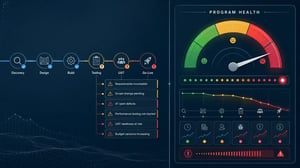
Most Order Management System (OMS) implementation post-mortems never get written. When a program runs 10 weeks over schedule, accumulates 120+ open defects going into UAT, or burns through $200K more than a retailer budgeted for the project, the instinct is to close the wound and move on. Nobody writes the case study.
We're going to write the post-mortem. Not with names attached, but with enough honesty to be useful.
OMS implementations typically go off track for three recurring reasons: requirements are not fully defined before development begins, UAT becomes the first realistic end-to-end test, and implementation decisions are mistaken for platform limitations. Retailers can reduce risk through structured discovery, clear decision ownership, formal change control, and production-like testing before UAT.
Across more than 150 OMS engagements involving IBM Sterling, KIBO Commerce, Salesforce, and custom platforms, we've watched the same failure patterns surface repeatedly. The retailers, technology stacks and program budgets may be different, but the underlying problems are often remarkably similar.
In many cases, the primary issue is not the OMS platform. It's the process. It's how the program handles requirements, governance, architecture, testing, and decision-making.
Failure Pattern 1: Requirements Were Never Truly Finished
Some of the most expensive OMS overruns we've seen begin with a statement of work that was scoped before the business fully defined what it needs.
A retailer may say it wants to enable buy online, pick up in store. But “enable BOPIS” can mean very different things:
-
Will all 300 stores participate, or only 50 pilot locations?
-
Will stores fulfill from a shared inventory pool?
-
How long does a store have to accept and pick an order?
-
What happens when an item cannot be located?
-
Can orders be partially fulfilled or reassigned?
-
Which systems control customer notifications, cancellations, and refunds?
These details determine the architecture, integrations, effort, and cost. When they are left unresolved, they do not disappear. They surface later as design changes, development rework, testing defects, or change-order disputes.
Requirements will evolve during an implementation. That is normal. The risk comes from allowing scope to change without a defined process for evaluating the timeline, cost, and architectural impact.
The financial conversation that happens in month eight should have happened in week two. By month eight, much of the budget may already be committed and trust between the teams may already be strained.
Failure Pattern 2: UAT Treated as Testing Instead of Validation
User acceptance testing (UAT) should not be the first serious test of the system. UAT is intended to confirm that the solution supports the agreed business processes. Core functional, integration, regression, and critical performance testing should be substantially complete before business users begin validating realistic end-to-end scenarios.
Before business users enter UAT, core functional testing, integration testing, regression testing, and critical performance testing should be substantially complete.
When UAT becomes the first serious test of the system, business users start finding issues that should have been identified weeks earlier:
-
Orders are not routing correctly.
-
Inventory updates are delayed or inconsistent.
-
Tax, payment, or fraud integrations fail under specific conditions.
-
Store associates cannot complete exception workflows.
-
Performance degrades when realistic transaction volumes are introduced.
We have entered UAT kickoffs where the backlog contained more than 100 unresolved defects. At that point, UAT is no longer validating the solution. It is helping the implementation team discover whether the solution works.
That discovery should have happened much earlier.
Failure Pattern 3: The Platform as Scapegoat
When an OMS program struggles, the platform is often blamed first.
The system is described as too rigid, unable to scale, or incapable of supporting a particular requirement. Sometimes that assessment is valid. Platform selection matters, and no OMS is the right fit for every retailer.
But the root cause is often more ordinary:
-
The business requirement was never fully defined.
-
The solution was not architected around the retailer’s operating model.
-
Integration complexity was underestimated.
-
Performance requirements were not documented.
-
Production-like volumes were introduced too late.
-
Customizations created unnecessary technical debt.
A poorly scoped implementation of a suitable platform can fail just as easily as a well-managed implementation of the wrong platform.
Successful programs evaluate platform fit honestly, but they also distinguish between a product limitation and an implementation decision.
What the Successful Programs Have in Common
The strongest OMS programs are not necessarily the ones with the largest budgets or the most sophisticated technology. They are the ones that establish discipline early.
Common characteristics include:
-
A structured discovery phase, often 4 to 6 weeks, that produces requirement documents the business actually signs off on
-
A formal change-control process in which cost, timeline, and architectural impacts are evaluated and approved before additional work begins
-
Application performance monitoring (APM) tooling activated before UAT, not after go-live.
-
A defect severity matrix agreed before testing begins, not debated during it
-
A single accountable client-side owner with the authority to resolve cross-functional decisions
None of these are controversial. Most of them appear in the vendor's implementation methodology documents. The gap is execution, particularly the willingness to have an uncomfortable conversation early, while the problem is still inexpensive to fix.
Is your OMS implementation already showing warning signs?
Whether you are preparing for an OMS implementation or trying to stabilize one already in progress, the earliest signals are often visible before the program misses a major milestone.
Use the 12-point OMS Implementation Risk Checklist to evaluate scope, governance, architecture, testing, and go-live readiness before small gaps become expensive.
Frequently Asked Questions
For a complex enterprise retail implementation, discovery often takes four to six weeks. The appropriate duration depends on the number of channels, fulfillment locations, integrations, markets, brands, and business processes involved. The objective should be to resolve critical operating-model and architecture decisions before detailed development begins.