


When "In Stock" Becomes a Broken Promise
Available-to-promise (ATP) inventory visibility is transforming how retailers handle both stock and customer expectations.
I remember the last time I pre-ordered a pair of limited-edition sneakers. The website showed “available now,” so I checked out immediately seeing them in stock. Two days later came an email: “Sorry, your order is delayed due to inventory issues.”
My excitement vanished. Worse, I started wondering if competitors with better real-time inventory visibility would have been more transparent.
As a customer, I don’t want retailers making decisions for me. Don’t tell me it’s “in stock” if it isn’t. Tell me when it will actually be available and let me decide if I want to wait. Sometimes I’ll happily wait two weeks if I know the item is inbound. But I want to make that choice, not be surprised later.
This frustration highlights a bigger issue in traditional inventory management. On-hand inventory systems were built for a simpler time when inventory was either in the warehouse or it wasn’t. But modern omnichannel supply chains are dynamic. Products are constantly in motion—purchase orders with suppliers, transfer orders between locations, inbound shipments on trucks, or even customer returns being processed.
If your system only tracks what’s on the shelf right now, it’s missing half the picture. That gap directly translates directly into missed sales, broken trust, lost loyalty and abandoned carts.
At Nextuple, we call this the availability gap. It’s the difference between what inventory management systems see and what customers need to know.
Costs of the Availability Gap
Limited inventory visibility has a major business impact. U.S. retailers lose an estimated $1 trillion annually to out-of-stock situations, many preventable with future ATP visibility. A survey by AlixPartners found that nearly 66% of consumers will leave an online or physical store and shop elsewhere when a desired item is out of stock.
The bottom line is simple. When you don’t know your stock accurately, you’re giving up revenue and even loyalty by the boatload.
Limitations of On-Hand Inventory in Omnichannel Retail
The traditional model is binary. If inventory is physically available, it can be promised. If not, it’s marked as out of stock. This approach fails modern customer expectations.
In today’s omnichannel world, customers expect more. Shoppers want to know:
Can I get it today?
If not, when will it arrive?
Is it worth waiting for the promised date?
If retailers can’t answer with confidence, customers will click away to competitors who can.
Future inventory visibility solves this by factoring in not just on-hand stock but also confirmed inbound supply. Purchase orders, transfer orders, shipments, and returns are connected into a forward-looking supply calendar.
Future Real-time Inventory Visibility Business Benefits
It delivers three critical advantages:
- Smarter promises with realistic delivery dates instead of guesswork.
- Optimized fulfillment by sourcing from the earliest available supply—even if it’s still in transit.
- Fewer lost sales by showing replenishment timelines instead of “out of stock.”
A sneaker brand can launch pre-orders weeks before 10,000 units arrive. A grocery chain can reduce cart abandonment by showing replenishment dates. A distribution center can capture orders today for a truck arriving tomorrow—without costly expedited shipping.
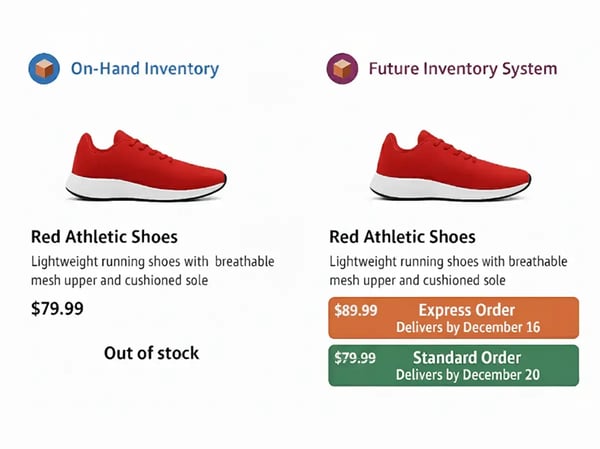
Example: An e-commerce site running only on-hand visibility shows “Out of Stock” the moment inventory hits zero. But a future-ready system knows a PO is arriving on December 15 and offers customers delivery choices—express on December 16 or standard on December 20. That transparency changes a lost sale into a captured one.
Common Challenges of Future Availability Implementations
Of course, achieving future ATP visibility presents real challenges for retailers. Many retailers attempt to extend availability but quickly run into obstacles. Some of the biggest challenges include:
System Integration Complexity
Inventory data doesn’t live in one place. Order management systems (OMS), warehouse management systems (WMS), enterprise resource planning (ERP), and procurement systems all generate pieces of the supply picture. Businesses with multiple warehouses, distribution centers and sales channels face difficulties keeping stock information synchronized across locations.
Integrating these diverse, often legacy systems seamlessly is complex and prone to inconsistent formats, and latency issues that make unified visibility difficult.
Data Reliability Issues
Future availability is only as accurate as the data behind it. If purchase orders are late, or duplicated in systems, or aren’t updated when canceled, you end up promising against inventory that never arrives. Without timely synchronization, phantom stock and overselling become inevitable.
Timing Mismatches and Disruptions
Supply timelines and customer demand timelines don’t always align. Unexpected events can throw off carefully calculated promises:
- Customs delays extending transit by days or weeks
- Weather disruptions rerouting shipments
- Supplier production delays pushing purchase order dates
- Carrier capacity constraints during peak seasons
Even with perfect data integration, the dynamic nature of supply chains creates ongoing operational challenges requiring intelligent exception handling and rapid promise recalculation.
These challenges force many businesses to default back to the “safe” option of only promising from what’s currently on the shelf, leaving revenue on the table every day.
Building Accurate Future Inventory Systems: Best Practices
Achieving accurate, forward-looking inventory visibility is difficult, but not impossible. Retailers that succeed take a structured approach to addressing the biggest pitfalls:
Reliable Data Through Real-Time Updates
Inventory needs to move away from batch updates to near real-time synchronization of supply signals—such as stock receipts, PO cancellations, or quantity modifications. Just as important, the inventory service itself should be able to publish near real-time available-to-promise (ATP) updates so external systems always have the correct visibility. Solutions like the Nextuple Inventory microservice accelerator are built around this principle, ensuring promises are based on the latest picture and reducing overselling, under-promising, and stale data.
Dynamic Supply Reallocation
Future inventory systems must dynamically reassign orders between on-hand and inbound supplies as supply signals evolve, or orders change. Intelligent, configurable inventory management automatically absorbs order cancellations, supply adjustments etc. to continuously optimize fulfillment —without time-consuming manual intervention. This will ensure that promises are realigned dynamically.
Strong Governance and Exception Handling
Even the best data pipelines have anomalies—duplicate POs, delayed shipments, or canceled transfers. Future inventory systems must embed governance, flagging inconsistent or inactive records and triggering alerts when anomalies arise. Exception handling frameworks ensure poor-quality signals don’t distort availability calculations, maintaining credibility with both operators and customers.
Building Confidence Through Phased Adoption
Teams are often accustomed to promising only what’s on the shelf, so shifting to a forward-looking model can feel risky. The key is to phase adoption: start with controlled pilots such as one category or a single fulfillment channel. Share outcomes—higher conversions, reduced lost sales, more accurate deliveries—to build confidence internally. Over time, scale adoption across more categories and channels, while training teams on new processes and embedding a culture of trust in predictive promises.
The Payoff: Building Trust Through Future Inventory
Adopting future inventory visibility is not just a technical upgrade—it’s a competitive necessity. Businesses that can combine on-hand and inbound supply into a single, forward-looking view unlock clear advantages:
- Revenue Growth by capturing pre-orders and preventing lost sales.
- Operational Efficiency through smarter sourcing and fulfillment choices.
- Customer Loyalty by setting promises they can actually keep.
But the real competitive advantage is trust.
Customers don’t want retailers making decisions for them—whether to cancel, substitute, or delay. They want transparency and the ability to choose. By showing accurate availability and delivery timelines tied to real inbound supply, you put control back in the customer’s hands.
Think back to that sneaker order. The frustration wasn’t the wait. It was the uncertainty and broken promise. If the retailer had told me upfront, “This will ship in three weeks based on our confirmed supply,” I likely would have placed the order anyway. I just wanted the choice and the confidence the promise would be kept.
That’s what future inventory delivers: not just better planning or operational efficiency, but a customer experience built on honesty and empowerment.
In a world where a single poor delivery experience can cost you a repeat customer, this shift matters.
The availability gap is widening into a competitive divide. Forward-thinking retailers are implementing future inventory while competitors still display vague "out of stock" messages. As consumers experience accurate availability promises from market leaders, their expectations rise—making binary on-hand inventory increasingly unacceptable.
The next time your customer clicks “buy,” you have the choice: leave them in the dark with an uncertain promise or win their trust with specific availability dates you know you can stand behind.
Want to see how you can improve inventory visibility? Talk to our experts.