


Skip to content

Summarize with AI

Executive Summary

An order management system (OMS) transformation is one of the highest-stakes technology decision that retailers make. It touches every channel, every fulfillment node and nearly every core enterprise system. Yet more than half of these programs underperform; not because of bad technology, but because critical architectural and strategic decisions were made too late, with too little information.

The challenge runs deeper than integration. Legacy OMS platforms have been customized over years to handle far more than order management, like pricing, promotions, B2B workflows and more. That landscape often doesn’t map cleanly to a modern architecture where different systems own different capabilities. Without clear definition of what belongs inside the new OMS and what falls outside it, teams discover midbuild that entire capabilities need to be rehomed. Scope expands, timelines stretch and budgets overrun. 

iStock-1387134070
Nextuple-Phase-Zero-Icon-Warning

 50%+ 

of large-scale tech transformations fall short of business expectations 
Nextuple-Phase-Zero-Icon-Strategic-Lifespan

 7-10 yrs  

average strategic lifespan of the right Order Management System decision 

Nextuple-Phase-Zero-Icon-Project-Cost-Overrun

 45%  

 average project overrun on large-scale technology projects  

What Is Phase Zero in an OMS Transformation?

Phase Zero is a structured planning and decision framework completed before vendor selection and implementation. It defines the business case, target-state architecture, integration requirements, program scope, organizational readiness, and evaluation criteria needed to make a high-confidence OMS decision.


The Case for Phase Zero

Phase Zero is a foundational decision framework that happens before contracts or implementation. It maps the gap between your current-state and target-state architecture, aligns business and IT stakeholders around a shared blueprint, flags integration risks, models total cost of ownership and evaluates your options (build, buy or hybrid) before you commit. It also defines how to structure the program and assesses organizational readiness: the roles, skills and capacity your team needs to execute.

The outcome is a technology choice grounded in your reality, a sequenced implementation roadmap and true alignment across commerce, supply chain, store ops, finance and IT. Phase Zero doesn’t slow your transformation down. It prevents the costly rework and timeline extensions that do. Nextuple has refined Phase Zero across large OMS programs for retailers, grocers and 3PLs. We are OMS focused, vendor neutral and bring deep production experience across every major platform.

1 Bain & Company, Product Management: The Key to Unlocking Return on Your Software R&D Investment
2 McKinsey & Company, Delivering Large-scale IT Projects on Time, on Budget, and on Value
Nextuple-Phase-Zero-Why-OMS-Transformations-Underperform

Why Most OMS Transformations Underperform
OMS complexity is systematically underestimated and the instinct is to move straight to demos. But an OMS is not a standalone system. An OMS is an orchestration layer that integrates with nearly every core enterprise platform. An OMS touches your commerce platform, ERP, WMS, TMS, POS, payment systems and increasingly, AI and data platforms. When organizations skip the architectural groundwork, the consequences compound across every one of these connections.

What Goes Wrong Without Upfront Design

ROI and business case

drift from original projections

By the time the project goes live, the original business case may no longer hold. Stakeholder confidence erodes and the transformation is judged a disappointment even if it eventually delivers value.

 
Scope and ownership unclear

no agreement on system handling

Without upfront alignment, stakeholders carry different assumptions about which capabilities belong to the OMS, which belong to the WMS or ERP, and which fall into gaps between systems.

 
OMS boundaries are undefined

new architecture is never a 1:1 mapping

 Legacy platforms have absorbed pricing, promotions, B2B workflows and custom apps over the years. Without clarity on what belongs inside the new OMS teams discover mid-build that entire capabilities need to be re-homed. 

 
Project timelines

stretch, sometimes by months

Unplanned scope additions cascade through dependent workstreams. A 6 month implementation quickly becomes 10 months, with mounting costs and organizational fatigue.

 
Integration assumptions

become expensive surprises mid-project

A single missed API dependency between your OMS and another system can require weeks of unplanned development and testing, which can multiply the cost of identifying it upfront.

 
Underscoped change management

unprepared for how much will change

An OMS transformation can change how stores fulfill, how teams collaborate and how decisions get made. Without assessing organizational readiness upfront, training gets rushed, adoption stalls and teams revert to old workflows.


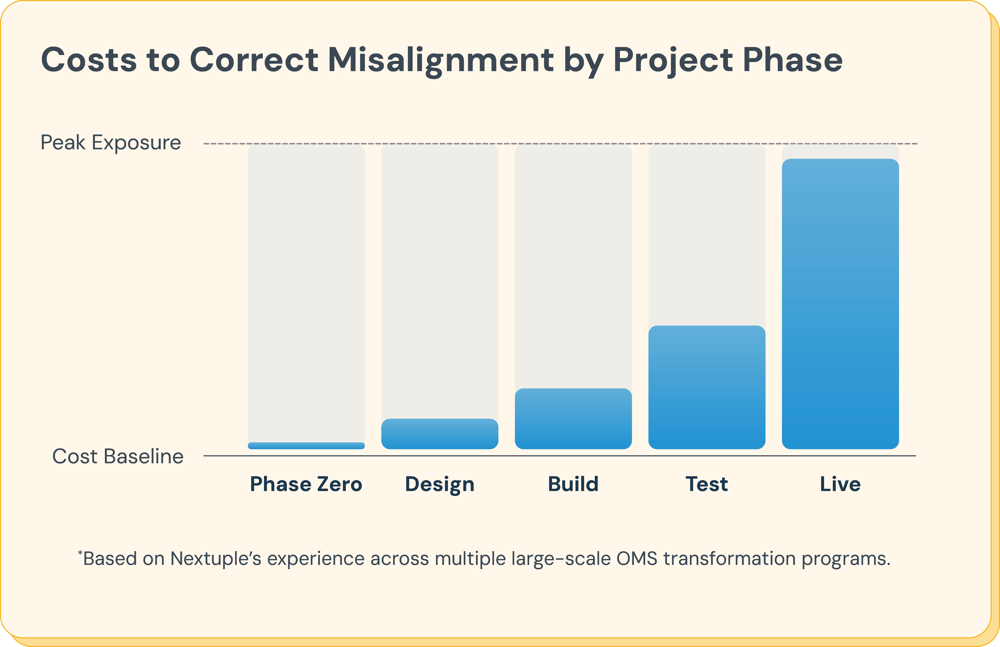
The Cost of Discovery Grows Exponentially

The later that architectural misalignment is discovered, the more costly it becomes to correct.
Switching platforms midstream is rarely viable—making Phase Zero not an overhead, but insurance.

Nextuple-Phase-Zero-Graph-Costs-to-Correct-Misalignment
iStock-1827291486

What Phase Zero Actually Includes

Phase Zero is not a preliminary workshop. It is a structured decision framework that precedes vendor contracts and implementation. It is designed to protect your investment and eliminate costly surprises before they happen.
ROI and Business ObjectivesDefine measurable outcomes tied to real KPIs—not feature wishlists.
Architecture and Process BlueprintDeep assessment of your existing systems and futurestate enterprise architecture blueprint.
Cross-Functional RequirementsCommerce, supply chain, store ops, finance, and IT aligned from day one.
Total Cost of Ownership ModelingTrue total cost of ownership across licensing, implementation, and operations.
Program Structure Definition

Phasing, sequencing and dependencies mapped to your business priorities and organizational capacity. 

Integration Impact Analysis Every system connection rated upfront. identified, scoped, and risk-rated upfront.
Data & AI ReadinessEvaluate your data maturity, quality and infrastructure to determine readiness for AI-powered capabilities
Change Management FrameworkAssess organizational readiness, define the roles and skills needed, and plan for adoption.
Implementation RoadmapPhased, executable plan sequenced around business priorities.
Nextuple-Phase-Zero-Icon-Tile-Key-Principle

Key Principle

Vendor selection should be the output of Phase Zero, not the starting point. Most organizations narrow to 2 or 3 vendors and retrofit requirements around those platforms. Phase Zero inverts that: requirements, architecture and approach (build, buy or hybrid) come first, with vendor selection following as a natural conclusion.

What Phase Zero Ultimately Delivers

Nextuple-Phase-Zero-Right-Technology-Selection 02
Right Technology Decision

Technology decisions grounded in your architecture, complexity and roadmap, not industry hype or demo quality. Phase Zero produces a structured evaluation that scores each option (build, buy or hybrid) against weighted criteria specific to your organization:

  • Strategic alignment with your business model
  • Cultural fit with your organization
  • Product capability against prioritized use cases
  • Scalability for future growth
  • Total cost of ownership realistic and fully modeled
  • Integration compatibility across your enterprise stack
  • Composability and extensibility for incremental modernization
  • Organizational readiness to execute and sustain the transformation
The right approach for one retailer may be the wrong one for another.
Nextuple-Phase-Zero-Architecture-Blueprint 02
Architecture Blueprint & Roadmap

A target-state architecture that defines what belongs inside the OMS and what falls outside, paired with a phased implementation plan aligned to your priorities and capacity. This sequence illustrates a common pattern; actual phasing is tailored to your starting point:

  • Inventory Visibility: Foundation layer know what you have, where
  • Sourcing Logic: Routing rules, ATP, costto-serve optimization
  • Store Enablement: BOPIS, SFS, curbside, return flows
  • Channel Expansion: New channels integrated rapidly
  • AI Optimization: ML-driven promising, routing, reconciliation
Clarity entering the implementation phase prevents reactive firefighting.

Why Nextuple for Phase Zero

Built exclusively for Order Inventory Management since day one.

Deep OMS Expertise

Decades of real-world experience across IBM Sterling, Manhattan, Kibo, Blue Yonder and others, in production retail environments, not just consulting engagements. We know these platforms inside and out: their capabilities, their limitations and what it actually takes to implement them. We also know what it takes to build, having developed custom microservices and composable solutions alongside major OMS platforms.

Vendor & Approach Neutral

We’re here to make sure you make the right decision before you commit. Whether the right answer is a full platform, a composable strategy, a hybrid architecture or a retailerled custom build, we guide you there through structured evaluation balancing strategic fit, TCO, integration complexity and your longterm roadmap.

Methodology Refined in the Field

Phase Zero is not theory. It is a discipline refined across multiple large-scale OMS programs, from mid-market specialty retailers to enterprise grocers and 3PLs, spanning full platform implementations, composable modernizations and custom builds.

Capabilities We’ve Help Build

Get in Touch

Start your OMS Transformation Journey the Right Way.