


Walk into a big-box retailer during a holiday weekend and the capacity problem is easy to see. Long checkout lines, near-empty shelves, store associates scrambling to keep up with a backlog of online orders, and equipment sitting idle because the right people are not in the right place at the right time.
For many retailers, capacity planning is still treated like a labor scheduling problem. It is not.
It is an orchestration problem across people, processes, equipment, physical space, and demand, all moving at the same time. Two-thirds of organizations say forecasting and misalignment between capacity and demand are their biggest resource management challenges.
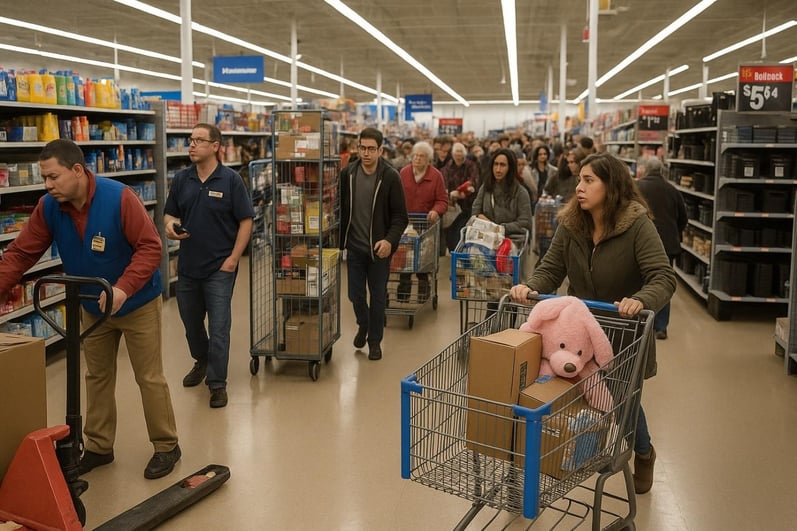
Retail capacity planning is the practice of aligning labor, equipment, physical space, task throughput, and demand signals so stores and fulfillment locations can operate effectively as conditions change. In modern retail, capacity is not a fixed daily number. It changes by hour, channel, location, skill set, inventory flow and customer demand.
For retailers managing hundreds or even thousands of stores, these inefficiencies quickly add up: lost sales, higher labor costs, dissatisfied customers, and employees stretched thin. Capacity planning optimization is no longer just about counting heads or tracking working hours. It’s about orchestrating people, processes, tools, environment and demand in a way that adapts dynamically to business reality.
This is the exact problem we help retailers think through at Nextuple, moving beyond static scheduling into dynamic, multi-dimensional capacity planning. Before we get into what a different approach looks like, it's worth understanding what "capacity" actually means in a modern retail environment, because the answer is more layered than most systems account for.
What Are the Key Dimensions of Retail Capacity Planning?
Retail capacity planning works only when it accounts for the full operating environment, not just the number of people scheduled for a shift. Capacity in modern retail and distribution is not a single dial you turn. It’s the result of several interconnected dimensions, all influencing one another at the same time. Most traditional systems only address one of them and treat everything else as someone else’s problem. That’s a gap worth understanding before evaluating any solution.
Workforce Capacity
Your human capital. This is where most retailers start and it goes well beyond headcount. Effective workforce capacity is shaped by skill mix, cross-training depth, fatigue patterns and real-time availability. A store may have 40 associates on the schedule, but if only three are certified to operate forklifts and all three are on the next shift, you have a capacity gap right now that no scheduling system will flag. The human capital dimension is foundational, but it’s never the whole picture.
Time and Scheduling Capacity
Capacity is not a fixed number for the day. It changes shift to shift and in high-volume environments, it can shift by the hour. How you slot shifts, manage peak versus off-peak windows and allow for real-time adjustments determines whether your resources actually align with demand when it spikes or when it drops. A store that’s perfectly staffed at 10 a.m. can be critically understaffed by 2 p.m. if the scheduling model doesn’t account for intraday variability.
Process and Task Throughput
Every operational task in a store or DC has a throughput ceiling: picking, stocking, checkout, replenishment, returns processing. That ceiling is set by routing logic, batching efficiency and the bottlenecks baked into your current workflows. Even a small inefficiency in one process ripples across the system, because these tasks are interdependent. A slow replenishment cycle means empty shelves, which means more customer complaints at checkout, which means longer lines, which means associates pulled from other tasks. It compounds.
Equipment, Tooling and Physical Layout
Machines, scanners, forklifts, POS terminals, robotics and the physical space they operate in all carry their own constraints. Idle tools, maintenance downtime and poor allocation reduce your usable capacity just as much as being short-staffed. And the store layout itself matters more than most people think: aisle width, congestion zones, travel time between pick locations, and ergonomic factors all affect how quickly staff and equipment can actually move and perform. This is often the most underappreciated limiting factor in the entire capacity equation.

Demand and Customer Flow
Customer behavior is part of the capacity system, whether you model it that way or not. Demand peaks, promotional spikes, queue dynamics, order abandonment, and channel shifts between in-store and online all pressurize capacity boundaries in ways that are difficult to predict with static models. A BOPIS surge on a Tuesday afternoon looks very different from a Saturday foot traffic peak, and the capacity response needs to be different too.
Data Visibility and Dynamic Optimization
A capacity model is only as good as the data feeding it. KPIs, benchmarking, event streams, and demand forecasting are what allow you to see how much capacity you truly have at any given moment, or how much you lack. But visibility alone isn’t enough. The real differentiator for modern systems is the ability to act on that data in real time: flexing capacity through overrides, no-code rule changes, and event-driven controls. That’s what turns a static capacity number into something that actually responds to the business as it’s happening.
Why Traditional Capacity Planning Software Fails Modern Retailers
The challenge for most retailers isn’t that they don’t know these factors. It’s that traditional capacity and scheduling software wasn’t designed to handle this level of complexity or dynamism. Workforce management software in retail alone is projected to grow to $3 billion by 2033, yet the market still overwhelmingly focuses on scheduling rather than holistic capacity modeling.
Here’s what that gap looks like in practice:
- Systems only account for labor hours, ignoring tools, process bottlenecks and demand shifts. Adding new capacity types (e.g., new picking zones, robotic equipment, or self-checkout terminals) requires heavy IT customization.
- Exceptions and overrides for special local events or weather-related surges are handled manually, creating errors.
- Reporting is backward-looking, with limited event emission for real-time KPIs.
The result? Retailers are left with rigid capacity systems that don’t reflect reality. Workers are either underutilized or overwhelmed, customers wait longer and the business misses opportunities to optimize the resources it already has.
Traditional Capacity Planning vs. Dynamic Capacity Planning
Traditional capacity planning usually starts with labor hours and fixed schedules. Dynamic capacity planning starts with the reality of the operation: who is available, what skills they have, what equipment is usable, where demand is spiking, which tasks are backing up, and what rules need to change in the moment.
The difference matters because modern retail conditions rarely hold still. A store can be properly staffed on paper and still be constrained by the wrong skill mix, unavailable equipment, a replenishment bottleneck, or a pickup surge that the schedule never anticipated.
What Should Modern Retail Capacity Planning Include?
A modern capacity planning approach needs to model the actual constraints inside the store or fulfillment environment. That means labor matters, but so does equipment availability, task throughput, demand spikes, local exceptions and the ability to adjust rules without waiting on a long development cycle.
- Dynamic Capacity Modeling – Add any type of capacity (people, tools, machines, slots) on the fly without lengthy IT projects.
- Slot-Level Flexibility – Enable different slots for different capacity types, whether it’s cashier hours, forklift availability, or self-checkout counters.
- Low-Code Rules Engine – Most add-on features can be configured via rule changes, not development cycles. Business teams stay in control.
- Exception & Override Handling – Easily adjust capacity for promotions, weather disruptions, or local events without breaking the system.
- Event-Driven Architecture – The accelerator emits rich events in real time, giving you the ability to track and analyze KPIs across workforce, tools, and processes dynamically.
How Dynamic Capacity Planning Impacts Retail Performance
The difference between static and dynamic capacity planning is easiest to see when conditions change fast, which, in retail, is most of the time.
Consider a scenario most Midwest retailers know well: a major snowstorm is forecast for the weekend. Customers flood stores for essentials days ahead of the event. In a static capacity environment, the scheduling software can't adjust to the surge. Checkout lines snake through aisles. Shelves empty because replenishment teams are understaffed for the volume. Forklifts and pallet jacks sit idle in the backroom because the associates certified to operate them aren't on shift until tomorrow. The store has the equipment. It has the inventory in the back. It even has associates on the floor. What it doesn't have is the ability to reallocate those resources in real time to match what's actually happening. The result is lost sales, frustrated customers, and exhausted employees who absorb the stress of a system that can't flex.
Now picture the same storm, same surge, but with a dynamic capacity model underneath. The system picks up the demand spike through real-time signals. Store managers reassign capacity slots, pulling in additional staff for checkout and replenishment without having to call a regional manager for approval. Equipment availability is factored into the allocation, so certified operators get matched to the tools that need them. Exceptions for the weather event are added through simple rule changes, not IT tickets. And because the system emits events in real time, district and regional leadership can see which stores are absorbing the surge well and which ones need intervention, before customers start posting about it on social media.
The gap between these two outcomes is not theoretical. It's the difference between a store that loses $50,000 in a weekend and one that captures it. Multiply that across hundreds of locations and a handful of demand disruptions per quarter, and the financial case for dynamic capacity planning becomes difficult to ignore.
This tracks with what Deloitte's 2026 retail industry outlook is signaling: retailers investing in real-time operational agility are consistently outperforming peers who treat technology upgrades as one-time projects. The retailers pulling ahead aren't the ones with the biggest budgets. They're the ones whose systems can adapt when the plan doesn't hold.
Moving From Static to Dynamic Capacity Optimization
Capacity optimization is not just about managing labor. It’s about orchestrating every moving part in the store ecosystem, from people and scheduling to processes, equipment, physical layout and demand, with enough agility to respond when conditions change mid-shift.
The path forward starts with an honest assessment: does your current capacity model account for more than headcount and shift hours? If it doesn't, you're optimizing a fraction of the system and wondering why the whole thing underperforms.
At Nextuple, this is the problem we help retailers work through. Our capacity accelerator was built specifically for this kind of multi-dimensional complexity, dynamic modeling, slot-level flexibility, a low-code rules engine, and real-time event-driven visibility. But the technology is only part of it. The harder work is mapping your capacity dimensions, understanding where the real constraints live and designing an operating model that can flex when the business needs it to.
At the end of the day, capacity is not fixed. It's dynamic. And if your systems don't reflect that, you're leaving real revenue and customer loyalty on the table.