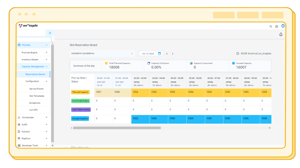




A large wholesale club implemented Nextuple’s Enterprise Inventory Service across its organization within four months, adding inventory visibility, monitoring and reconciliation capabilities.

Nextuple Order Management Studio
Build Inventory & Order Promising Capabilities on Your Terms
Building your own OMS or extending the capabilities you have? Nextuple combines reusable microservice accelerators with engineering expertise to help your team build real-time inventory availability, accurate delivery promising, sourcing and capacity capabilities without starting every component from scratch.
A Starting Point for Your Modern Build
When you choose to build, you still need to decide what to develop from scratch and where to use reusable components. Nextuple’s accelerators provide a starting point for inventory, promising, sourcing and capacity, with engineering support to adapt those capabilities to your requirements.
Use individual components or combine them as part of a new OMS build, a phased transition from a packaged platform, or an extension of your current environment. Nextuple works with your team to define the architecture, tailor the capabilities and deliver the integrations.
Promise & Inventory is part of Nextuple Order Management Studio, which also includes order orchestration accelerators and fulfillment accelerators for broader OMS programs.
Choose Your Path to Building OMS Capabilities
Build a New OMS
Use inventory and promising accelerators as building blocks within a custom OMS. Focus your team’s engineering effort on the workflows and decisions that need to be tailored to your business.
Replace Capabilities in Stages
Move selected inventory or promising functions out of a packaged OMS as part of a phased transition. Define how new and existing components will coexist while your target architecture takes shape.
Extend Your Current Environment
Add tailored inventory, promising, sourcing or capacity capabilities where your current systems need to do more. Integrate those capabilities into the environment you plan to retain.
Reassessing Build vs. Buy in the Age of AI?
If AI is changing how your team evaluates a custom OMS build, Nextuple can help you assess what to build and define where accelerators fit.
What Retailers Have Built with Nextuple
A large North American retailer used Nextuple’s Promising Engine to calculate delivery dates at sub-100 millisecond performance and enable a “Get it Fast” shopping filter.
Four Capabilities for Inventory and Order Promising
Use inventory, promising, sourcing and capacity accelerators individually or together. Build capabilities to calculate delivery dates, share inventory availability across channels and select fulfillment locations based on business rules, costs and capacity.
Promise Engine Accelerators for Delivery Date Estimation
Build delivery promise capabilities around your inventory, fulfillment network and business priorities. Nextuple’s promise engine accelerators help calculate estimated delivery dates and bring those estimates into the shopping journey.
-
Calculate delivery-date estimates for search results, product listing pages and product detail pages using inventory availability and sourcing rules.
-
Use predictive models informed by fulfillment and carrier performance to support delivery-date calculations.
-
Configure sourcing costs and penalties to reflect priorities such as speed, split reduction and cost optimization.
-
Tailor delivery promises by customer type, channel goals, product attributes, location capacity and fulfillment-node cutoffs.
Inventory Microservices for Real-Time Availability
Build a consistent view of inventory availability across sales and fulfillment channels. Our inventory microservices support demand and supply information, available-to-promise calculations and the visibility needed to investigate discrepancies.
- Use three decoupled microservices to support inventory data across sales and fulfillment channels.
- Manage demand and supply information, available-to-promise calculations, and inventory snapshots, audits, visibility and reconciliation.
- Share inventory availability earlier in the shopping journey and with marketplace partners.
- Use inventory visibility and traceability to investigate discrepancies across your network.
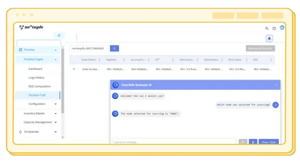
- Use the AI assistant to investigate available-to-promise inventory and understand node-selection decisions.
Fulfillment Capacity Management
Bring operational capacity into your fulfillment decisions. Nextuple’s capacity accelerator helps model the constraints that affect what your network can fulfill and when.
- Manage capacity across assets such as carriers, nodes, labor, and fulfillment types (Same Day, BOPIS, Ship-from-store, etc.)
- Define capacity across multiple units of measure such as units, lines, shipments, orders, or custom values.
- Manage capacity in various ways, such as cutoffs, capacity slots, and rolling consumption.
- Use an intuitive UI for set up and management and dashboards to isolate and solve capacity issues.
Fulfillment Sourcing and Optimization
Build sourcing decisions around the operational tradeoffs that matter to your business. Our sourcing accelerator supports configurable cost-based rules, simulation and decision traceability.

- Configure cost-based sourcing rules and penalties using relevant operational data.
- Set up cost templates using zone, product and carrier costs.
- Test sourcing configurations through simulation before promoting them to production.
- Trace sourcing decisions and understand the factors behind node selection.
- Assign relative weights to priorities such as speed, cost and split reduction.
- Use order and line attributes to inform sourcing decisions.
- For a deeper look at how retailers can move from rules-based decisions to AI-powered OMS sourcing, read our crawl, walk, run guide.
RESOURCES
Explore Inventory and Promising Resources
Learn how modern microservice-based Promising solutions can improve your customer experience with real-time inventory and promise calculations.
Inventory and Order Promising FAQs
Consistent availability starts with capturing inventory changes across the network, including sales, reservations, cancellations, returns and receipts. An inventory service uses those updates to calculate what each channel can offer, applying the relevant allocation and buffer rules. Channels may intentionally receive different quantities, but those quantities should come from consistent underlying data.
Discuss Your OMS Build or Modernization Plans
Tell us what you want to build and where your inventory and order promising capabilities need to improve.