

An order comes in for three items. One store has two of them. A warehouse across the country has all three. A second warehouse has a different pair. Somebody, or something, has to pick where this order ships from. That choice is what distributed order management is for.
Distributed order management (DOM) coordinates and optimizes order fulfillment across warehouses, stores, suppliers and third-party logistics providers. It uses inventory availability, delivery commitments, capacity, costs and business rules to determine how orders should be fulfilled. Many order management systems (OMS) include these capabilities.
With one fulfillment location, the location-selection problem is simpler. As more locations become available, the business has more choices about where to fulfill each item and whether to split an order. Poor decisions can increase costs, miss delivery promises or leave useful inventory untouched. This guide focuses on the sourcing and routing decisions within DOM: how they work, what they depend on and when your existing capabilities may be enough.
What Distributed Order Management Does
Within DOM, sourcing and routing involve four closely connected decisions:
-
Sourcing: which location should fulfill each item.
-
Allocation and reservation: how much available inventory to commit to the order, working with the system that owns inventory commitments. Platforms use different terms for these commitments, such as reservations, allocations or demand.
-
Splitting: whether to fulfill the order from one location or several.
-
Rerouting: whether and how to change the fulfillment plan when the original source cannot complete it.
Order routing and order sourcing describe much of this decision-making work. Routing determines where fulfillment should happen. Warehouse and store systems then execute the picking, packing and shipping.
Product boundaries vary. Some DOM offerings also manage broader order workflows, status changes and service processes. What matters is knowing which system owns each decision and how it coordinates with the systems around it.
DOM vs. OMS vs. Order Orchestration: Who Decides What
These three terms get mixed up constantly, and vendors use them loosely. OMS, DOM and order orchestration describe overlapping capabilities, rather than three universally separate systems. The distinction below is a practical way to understand their responsibilities. Individual platforms package them differently.
| Concept | Core Job | Typical Decisions | Data it Relies On |
| Order Management System (OMS) | System of record for the order from capture to completion | Order status, holds, changes, cancellations, returns handoff | Order, customer, payment and status data |
| Distributed Order Management (DOM) | Coordinates and optimizes fulfillment across a network; sourcing and routing are central capabilities | Fulfillment locations, requests for inventory commitments, splits and reassignment | Inventory availability, delivery commitments, capacity, costs and business rules |
| Order Orchestration | Coordinates the steps and handoffs around an order across systems | Sequencing, handoffs, exception handling | Events from the OMS, warehouse, stores and carriers |
In practice the lines blur. Many OMS products ship with DOM features built in. Some teams say order orchestration when they mean routing. Skip the labels and ask a simpler question: who decides where an order ships from, and can that logic change quickly when the business changes?
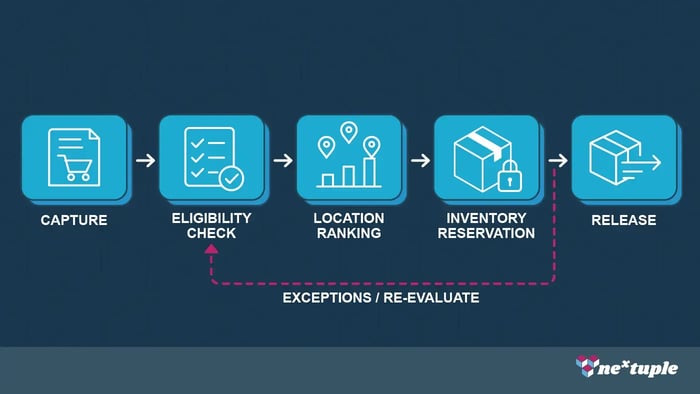
How Distributed Order Management Works, Step-by-Step
Implementations vary. Some evaluate individual orders as they arrive; others optimize groups of orders together. The following six steps show a simplified sourcing and routing flow.
-
Read the order requirements. Identify the items, quantities, destination, fulfillment method and delivery commitment. Related availability and sourcing calculations may already have informed the promise shown at checkout.
-
Identify eligible locations. Check which locations can supply each item and meet the relevant restrictions, including destination coverage, item handling, protected stock, capacity and carrier cut-offs. A location may be eligible for only part of the order.
-
Compare fulfillment plans. Evaluate individual locations or combinations of locations against the business objectives. These may include delivering faster than the committed date, controlling total fulfillment cost, reducing splits or using excess inventory.
-
Select the sources and split policy. Determine which locations should fulfill each line and whether a split is acceptable. These decisions may be evaluated together rather than as separate steps.
-
Confirm reservations and release work. Coordinate inventory commitments with the system that owns reservations. If availability changes before the commitment succeeds, reassess the plan before releasing fulfillment instructions.
-
Respond to exceptions. Use short-pick, rejection and delay events to determine whether the remaining work can be reassigned, held or backordered.
Exception handling depends on the order’s status. An order that has already entered picking may require cancellation or confirmation from the original location before another location receives the work. Recalculate the delivery expectation when the plan changes, and notify the customer if the commitment is affected.
How Sourcing Rules Work in Practice
Routing rules generally separate hard constraints from soft preferences. Hard constraints define which plans are allowed: each location must have enough available-to-promise inventory for the lines assigned to it, support the required handling and serve the destination. Protected stock, capacity limits and mandatory delivery commitments may also be constraints. Soft preferences compare the eligible plans, favoring lower cost, fewer splits, shorter transit times or excess stock. A preference must not override a mandatory requirement. The team needs to agree which rules belong in each group.
Networks with varied channels or seasonal peaks often need more than one rule set. Peak season calls for different priorities than a quiet week. Marketplace orders may carry tighter ship-by dates than your own web orders. Ship-from-store may be allowed only for certain items, or only for stores with enough staff on shift. A good setup keeps these as named profiles you can switch between without rewriting everything.
Whatever the rules are, treat them like code. Keep a history of changes, test them on past orders before release and keep a way to roll back fast.
Split Shipments: When They Help and When They Hurt
An order can be split across fulfillment locations or dispatched in separate shipments from the same location. The number of locations, shipments and parcels will not always be the same.
Splitting can help when it makes more inventory available or gets part of an order to the customer sooner. It can also add handling, packaging, transport costs and separate deliveries.
Rules should define when partial fulfillment is acceptable, how many fulfillment locations or shipments an order may use, and what benefit justifies the extra cost. Low-value orders may need tighter limits because an additional shipment can erase the margin. A single-location plan still needs a realistic packaging and parcel-cost estimate.
A Worked Example
Consider an illustrative order for a jacket, a pair of shoes and a belt, going to Boston with a Friday delivery commitment.
A Boston store has the jacket and belt. A western distribution center has all three items. An eastern distribution center has the shoes.
Assume the western distribution center can deliver the complete order by Friday. The store and eastern distribution center can also meet that commitment by fulfilling separate parts of the order. Both plans are eligible.
A rule favoring fewer fulfillment locations would choose the western distribution center. A rule favoring the use of excess store inventory could choose the split plan, provided its additional cost stays within an agreed limit.
Now suppose the western distribution center cannot deliver until Monday. If Friday is a mandatory requirement, its complete-order plan is no longer eligible, even if it costs less.
The useful question is not simply which location is closest. It is which fulfillment plan meets the requirements at an acceptable cost. Every rule needs an owner who can explain that tradeoff and approve changes.
What a Distributed Order Management System Depends On
A distributed order management system is only as good as three things around it.
Inventory you can trust. Routing against stock numbers that are wrong produces confident, wrong decisions, and the result is cancellations after the customer was promised an item. If inventory by location is not accurate and fresh, fix that first. This is why real-time inventory visibility often makes sense before any routing project: the system can only be as good as the stock picture it sees.
Honest capacity. For example, a store with three people on shift may not be able to pick forty ship-from-store orders by 4 p.m. A warehouse has carrier cut-offs. The system needs to know how much each location can actually handle today, not what it could handle on paper.
Rules with an owner. Every rule needs someone accountable for it, a way to change it safely and a way to test the change before it touches live orders.
The next question is where those capabilities should live.
-
Extend your current OMS. Configure or enhance its existing sourcing capabilities when they can support your requirements. Check rule flexibility, decision traceability and testing options before adding another system.
-
Add a specialist sourcing service. Use a separate service when the gap is concentrated in routing or optimization. This adds integration and operating responsibilities, including clear ownership of inventory reservations, releases and exceptions.
-
Include sourcing in a broader OMS modernization. When several capabilities need to change, assess sourcing alongside inventory, promising, orchestration and fulfillment. A composable approach may allow selected capabilities to move independently, but the dependencies still need to be designed and tested.
A separate sourcing service can itself be part of a composable architecture. These approaches are not mutually exclusive.
Before choosing, define which system owns reservations and releases. If a proposed source cannot reserve inventory, the order needs a controlled retry or alternative plan. If an order is reassigned, the original fulfillment request and inventory commitment must be resolved so two locations do not act on the same demand.
If a commitment spans more than one system, such as inventory and capacity, one can succeed while the other fails. Decide in advance how the successful commitment is reversed, what happens if the reversal also fails, and how a partial success on a multi-line order is reported.
Building your own engine gives you responsibility for the decision logic, testing, performance and ongoing operation. Integrating an existing engine shifts some of that work to a provider, but you still need to validate its behavior and fit with your environment.
Explore our sourcing and capacity capability accelerators, or read how to assess whether to augment or replace your OMS.
Common Mistakes with DOM Routing
Review these routing risks before launch. They are useful checks for requirements, configuration and testing. For the broader implementation picture, see why OMS implementations fail.
-
Designing for one channel without checking the others. Web delivery, store pickup and marketplace orders may have different inventory restrictions, cut-offs and service commitments. Identify those differences before treating one channel’s rules as the default.
-
Routing on inventory that is too stale for the use case. Define how fresh availability needs to be for each fulfillment flow. Delayed supply or reservation updates can make an apparently valid source unable to fulfill the order.
-
Letting rules pile up with no owner. Each exception makes sense when it is added. A year later nobody knows which rules still matter or what breaks if one is removed.
-
Ignoring location capacity. Sending work to the cheapest or closest location without checking whether it can handle it creates backlogs and late orders.
-
Optimizing shipping cost while quietly breaking the delivery promise. Cost-first rules can save on postage and cost more in cancellations, refunds and lost customers.
-
Copying legacy rules one-for-one. Old rules carry old workarounds. Moving them across unchanged brings the old problems into the new system.
When Your Existing Routing Capabilities May Be Enough
Not every routing problem requires a new system. Your existing capabilities may be enough if they can enforce the relevant inventory, capacity and delivery constraints, handle exceptions and let the team change rules at an acceptable pace. Location count alone is not the test. Two locations can create difficult tradeoffs, while a larger network may operate well with straightforward rules.
The signs that you have outgrown that setup are practical ones. People override routing by hand. Orders split more often than they should. Stock sits stranded in stores while distribution centers run short. Orders get cancelled after they were routed. If you are weighing whether to extend your current system or replace it, our guide to whether to augment or replace your OMS walks through the decision.
How to Evaluate Distributed Order Management Software
Whatever you shortlist, ask the same questions of every product:
-
Can a business user change a rule without waiting for a software release?
-
Can you simulate a rule change against past orders before it goes live?
-
Does it see inventory by location in close to real time?
-
Can it explain why it chose a particular location for a particular order?
-
How does it handle exceptions and reroutes?
-
What does it cost to change the system, not just to run it?
-
Can you export rule definitions and decision history, and what would need to be rebuilt if you changed platforms?
-
Does it fit your architecture, whether that is APIs, events or both?
-
Can you evaluate proposed routing decisions against real order and inventory data in a read-only shadow mode, without creating reservations or sending fulfillment instructions?
Ask vendors to demonstrate why a location was selected, which alternatives were rejected and which constraints affected the result. That decision history helps teams investigate problems and test changes. Routing and order promising also need consistent assumptions about inventory, capacity and transit time, so the fulfillment plan can support the date shown to the customer.
A sensible way to start
Choose a bounded starting point, such as one channel or fulfillment flow, while documenting the shared inventory and capacity it uses. Name the rule owner and write down the requirements the routing must satisfy.
Establish a baseline for fulfillment cost per order, split shipments, cancellations after routing and delivery-promise adherence. Compare proposed decisions with current routing before allowing the new logic to reserve inventory or release work. Historical replay can help, but it needs the inventory and capacity conditions that existed when those orders were placed.
Use the comparison to investigate tradeoffs. Fewer splits are useful only if the result still meets delivery commitments at an acceptable cost.
Are routing problems coming from your rules, your inventory data or the limits of your current OMS? Nextuple can help assess those dependencies and determine whether to reconfigure existing capabilities, add a specialist service or plan a broader modernization.