

Your next best customer may never see your homepage, your hero banner or your loyalty pop-up. Their assistant will check your inventory, your delivery promise and your return policy, then decide in seconds whether you get the order.
Agentic commerce lets AI assistants research, compare and purchase on a shopper’s behalf. For retailers, readiness depends on accurate inventory, reliable delivery promises and accessible order and returns data.
That isn't a 2030 prediction anymore.
In the last few weeks, three personal AI assistants that act on your behalf have hit the market. Meta launched Muse, a personal agent that runs on its own cloud computer and works in the background. OpenAI launched Dots, which it calls "always-on agents" with their own computer, browser and connections to thousands of apps. Then there's Instinct, a startup assistant you just text, and it books, orders and follows up for you. It partnered with Stripe so it can make purchases, and it now has its own email address so it can, in the company's words, handle a product return for you. xAI's Grok Bot works the same way: an AI teammate with its own computer that signs into the tools you already use.
I've started handing real work to one of these assistants myself. The lesson came fast. Once you delegate a task, you stop caring about the interface. You care whether the job got done correctly.
That's exactly how these assistants will treat retailers.
The agent is the new shopper, and it doesn't care about your banner
For twenty years we've optimized for a human with a browser.
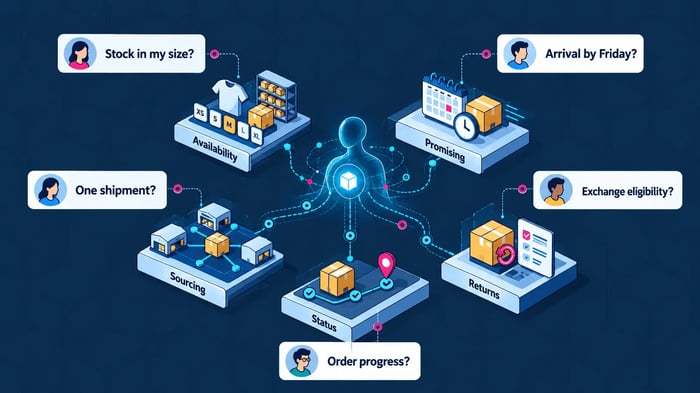
An agent shopping for someone optimizes differently. It asks plain questions. Is it actually in stock in the size my person needs? Will it really arrive by Friday? Will it come in one box or three? How painful is the return?
That traffic is already here. Adobe reports that traffic from AI sources to U.S. retail sites grew 393% year over year in Q1 2026, and in March it converted 42% better than non-AI traffic. A year earlier it converted 38% worse.
Adobe also found that about a third of the content on retail product pages can't be read properly by machines. The shoppers are arriving, and many retailers aren't legible to them.
Inventory accuracy and promise accuracy become ranking signals
Here's the shift most leaders are underestimating. For a human, a missed delivery date is a bad experience. For an agent, it's data.
An assistant that runs errands for millions of people will learn which retailers keep their promise and which ones oversell, slip ship dates or split an order into three shipments. That history will decide who gets recommended.
So inventory accuracy and promise accuracy stop being back-office KPIs. They become your search ranking. "In stock" on the PDP while the DC is empty used to cost you one cancellation. In an agent-driven world, it costs you future visibility.
What does agentic commerce require from your OMS?
The plumbing is being standardized right now. The Agentic Commerce Protocol, co-created by OpenAI, Stripe and Meta, defines how agents create, update and complete checkout sessions with a merchant. It expects the merchant to send order events back so the agent stays in sync with what OpenAI calls "fulfillment-grade truth." Google's Universal Commerce Protocol, built with Shopify, Etsy, Wayfair, Target and Walmart, covers discovery, checkout and post-purchase support. In both, the retailer stays the merchant of record.
Read those specs like an operator. They're really OMS specs. Real-time availability. Fulfillment options. Accurate totals and promise dates. Order status updates. Refunds.
If your available-to-promise is a nightly batch, your delivery date is a static "3–5 business days" and your order status lives in three systems, no protocol will save you. What looks like an AI readiness problem is, once again, an architecture problem.
Post-purchase becomes agent-to-agent
The biggest volume of these conversations won't happen at checkout. It will happen after.
"Where is my order?" "Can I exchange this for a medium?" "Start a return and send me the label." These are the tasks people most want to hand off, and they're exactly what fills your service queue today.
When the customer's agent is on one side, your side needs an agent too, one that's grounded in real order, inventory and returns data. It needs the authority to act inside guardrails: offer an exchange from store inventory, issue a label, refund on first scan.
Your own teams get assistants too
This isn't only about consumers. Dots already lets companies set up "specialist" assistants with their own identity and access controls. Grok Bot is built around AI teammates that work across the same apps your people use.
Picture an inventory planner whose assistant watches lead-time slippage overnight and has a rebalancing proposal ready by 7 a.m. Or a store manager whose assistant clears the BOPIS exception queue, or a customer service lead whose assistant drafts a resolution for every delayed order before the customer asks.
These assistants will act across OMS, WMS and ERP, so the same rule applies. Systems with clean APIs, clear permissions and trustworthy data get leverage. Systems that need a human to swivel-chair between screens get left behind.
The risks: margin, trust and data quality
Let's not pretend it's all upside.
Margin. An agent will price-shop on every order, without fatigue. Competing on banners gets harder. Competing on reliable promise, fulfillment cost and returns experience gets more important.
Trust and fraud. These platforms are investing heavily in permissions, approvals and protection against prompt injection, and that tells you how real the risk is. Retailers will need to know which agent is acting for whom, and with what authority.
Data quality. Agents are literal. If your catalog, inventory and policy data disagree, they won't guess generously. They'll move on.
What I'd do now, as a retail CXO
-
Measure promise accuracy like revenue. Know how often you deliver on the date you showed, by node and by channel.
-
Make inventory availability real-time and queryable. Move ATP out of batch and expose it through APIs, not just page renders.
-
Treat order status and returns as products. Agents will query them constantly. Make them accurate, fast and actionable.
-
Pilot one agentic checkout channel. Learn what your stack can and can't answer before the holiday peak teaches you.
-
Give one ops team an assistant. Start with planners or customer service, with clear guardrails and a human in the loop.
At Nextuple, this is what we obsess over: an order lifecycle that tells the truth, in real time, to whoever is asking. Increasingly, the one asking won't be a person.
Most retailers spent the last decade making their stack readable to search engines. The next one is about making it accountable to agents.
So I'm curious. If an AI assistant audited your promise accuracy tomorrow, would it recommend you? Join the discussion on LinkedIn.