

Skip to content
Case Study - Specialty Jewelry Retailer OMS Modernization

Case Study

A Retailer’s Omnichannel Modernization from Business Case to Continuous Value

-5% Late Orders to Customers
30% Proactive Late Order Alerts
48Hrs Dashboard Built & Deployed

"Our partnership with Nextuple began long ago when we needed to build a solid OMS foundation for our omnichannel commerce capabilities. What started as an engagement to develop both a business case and roadmap for an Order Management System has naturally evolved into a trusted, strategic relationship that continues to drive value for our organization while delivering for our customers and teams.”

Executive Summary


Seven years ago, a national specialty retailer set out to modernize order and fulfillment across banners and regions, with a clear mandate: build a durable OMS foundation and add high-value capabilities in rapid, low-risk increments. With over six major DOM releases in the first two years of the relationship, the team moved from core orchestration to a broad, flexible toolkit that now powers day-to-day operations and ongoing digital growth.

The journey began with a finance-grade business case and a structured RFP that selected a new OMS and defined a clear MVP. A phased roadmap followed, bringing a new order-management core to life across regions and standing up store-enabled fulfillment just as customer behavior shifted toward digital and curbside—capabilities that proved critical during an unprecedented period of disruption (the pandemic).

Post go-live of the MVP, the retailer moved from “stand up” to “step up,” focusing on fast, compounding wins and continuous optimization. First came curbside pick-up as well as same-day delivery to multiple last-mile partners, rolling out nationwide in weeks and embedding tracking and proof-of-delivery across customer and care experiences. Following the initial North America-based core DOM deployment, the team quickly expanded the scope of the solution to include all European brands. In parallel, the team defined and launched smarter sourcing to prioritize aging store inventory, redirecting a meaningful share of online orders from under-productive locations and clearing excess stock within a single quarter. Most recently, the retailer introduced AI/ML predictive promise dates for vendor-fulfilled items, tightening stated arrival windows across PDP, Cart, and Checkout while preserving on-time reliability.

The result is a flywheel: a modern omnichannel foundation that keeps paying forward with faster delivery options, smarter inventory utilization, and more credible promises—positioning the business for its next wave of growth. 

Executive Summary

A prominent American specialty retailer, offering a wide range of home furniture, decor, apparel, food products, and more, operates over 250 stores and a growing e-commerce platform. Seeking to enhance inventory visibility and optimize fulfillment across channels, the retailer partnered with Nextuple to modernize its order management system. By leveraging Nextuple’s expertise with legacy system transformations and IBM Sterling products, the company integrated a suite of solutions—including Sterling OMS, Call Center, Store, and IV —creating a unified commerce platform that enhanced customer experiences, boosted revenue, and drove operational efficiency.
Grocery 01

The Customer

One of North America’s largest specialty jewelry retailers, with 2,700 stores, nearly $7B in annual sales, is a category-defining, multi-banner retail leader operating at international scale with complex operations. The business serves customers online and across a large store footprint where trust, occasion-driven purchases, and delivery confidence are central to the experience. With growth in digital commerce and the need for unified, flexible fulfillment, the retailer prioritized building a modern order management foundation that could span banners, regions, and evolving customer journeys.

A Retailer’s Omnichannel Modernization from Business Case to Continuous Value 01

The Opportunities

  • Complex, multi-phase rollout. Spanning regions and banners required careful phasing, change management, and operational playbooks to protect day-to-day customer experience.

  • Speed with control. As expectations rose (and later, during pandemic disruption), the retailer needed to add new options quickly—store fulfillment (Ship-from-store & Buyonline- pickup-in-store), curbside, same-day delivery—quickly became business-critical.

  • Post-go-live value creation. With the core live, the opportunity shifted to new innovations and optimizations in flexible fulfillment: smarter sourcing, faster last mile, more credible promised dates, streamlined associate experiences, and lower cost to serve.

  • Fragmented foundations and limited growth. Legacy processes and point integrations made it difficult to present consistent fulfillment options, accurate availability, and credible delivery dates across banners and countries.

  • Executive alignment and prioritization. To secure funding and focus, the program needed a finance-grade business case, a clear MVP, and an executive-ready roadmap tying capability to revenue, margin, and customer experience.

  • Vendor selection at enterprise scale. The team required a defensible evaluation that balanced function, the right fit for scale, extensibility, TCO, and roadmap fit, culminating in IBM Sterling OMS selection.

The Challenge/Opportunity

The retailer’s challenges included fragmented inventory visibility, which impeded accurate order promising and efficient fulfillment across various channels. Additionally, the company needed to optimize sourcing decisions, ensuring orders were routed to the most efficient location—be it a distribution center, store, or vendor—while considering cost, stock availability, and customer preferences. The retailer also aimed to enhance its store fulfillment operations, particularly for Buy Online, Pick Up In-Store (BOPIS) and Ship-from-Store (SFS), while addressing labor capacity constraints.
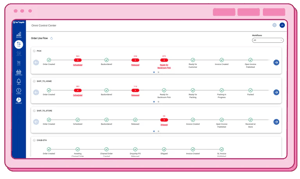
Orchestrate_OMNI Control Center Screenshot w frame

The Solution

The journey kicked off with a clear “Phase zero” plan. Nextuple partnered with the retailer to quantify the business case, translate benefits for senior leadership, and build a phased roadmap that tied capability to outcomes. With alignment in place, Nextuple designed and executed a structured RFP, defined evaluation criteria, ran scripted use-case demos, and facilitated scorecarding. The process led to the selection of IBM Sterling OMS as the platform of record and a well scoped MVP ready for delivery.

A Retailer’s Omnichannel Modernization from Business Case to Continuous Value 02

Foundation came next. In September 2020 the team launched the OMS MVP with BOPIS, Ship-from-Store, call-center order management, Mad Mobile integration, and operational reporting. A managed-services model stabilized run-state and protected peak while enabling incremental releases.

Expansion followed. By March 2021, SFS extended to additional banners, the U.S. stood up curbside and same-day delivery, and by August 2021 warehouse fulfillment, specialized flows (e.g., loose-diamond via R2Net), and broader reporting were live to support scale. 
The journey shifted from walk to run. In 2022 coverage grew to vendor dropship, special orders, and ship-to-store, alongside enterprise controls for payments, remorse/fraud holds, call center-enabled order modifications/returns/appeasements, sales posting, warranty activation, risk confirmations, and branded reverse-logistics journeys—sequenced to protect CX and unlock value.

With the core operating at scale, the focus shifted to continuous optimization based on the customers’ transition to an Iterative Product Managed delivery model. Flexible-fulfillment logic was tuned across stores, DCs, and vendors; DOM changes enabled faster digital-product releases; standardized adapters reduced integration effort; and automation improved support productivity and MTTR. In parallel, high-leverage capabilities compounded gains: AI/ML predictive promising for vendor-fulfilled items tightened stated delivery windows while preserving on-time reliability; a same-day gateway embedded booking, tracking, and proof-of-delivery; sourcing enhancements prioritized aging inventory without new infrastructure; and associate journeys (e.g., warranty upsell) were streamlined.

Throughout, the retailer combined internal engineering with targeted external expertise and microservice accelerators to compress timelines, de-risk integrations, and keep the platform resilient through multiple peak seasons, turning a phased rollout into a durable engine for ongoing omnichannel gains.

The Results


  • Foundation and scale. The retailer established a unified OMS operating across multiple banners and regions, bringing consistent order capture, orchestration, and service options to stores, DCs, and vendor flows. Store-enabled fulfillment (BOPIS, SFS) and curbside were live ahead of major demand shifts, preserving sales continuity and creating a single operating rhythm across channels.

  • Smarter inventory utilization. Sourcing enhancements prioritized aging and under-productive store inventory where appropriate, redirecting a meaningful share of online orders to clear stock without added infrastructure. In early waves, roughly 15% of online orders were fulfilled from under-productive locations, contributing to multi-million-dollar reductions in excess inventory within a single quarte 

  • Customer experience and speed. Same-day delivery was launched through a single gateway to multiple last-mile partners and rolled out to more than 2,000 stores in a matter of weeks. Over the first two years, the program fulfilled tens of thousands of same-day orders and drove multi-million-dollar incremental revenue, with tracking and proof-of-delivery embedded into care and customer experiences.
  • More credible promises. AI/ML-based predictive promising for vendor-fulfilled items shortened stated arrival windows while maintaining on-time reliability. Confidence thresholds and policy overlays (cutoffs, blackout days, exclusions) ensured a safe ramp, with automatic fallback to configured lead times when needed. 
  • Reliability and cost to serve. A dedicated run-state model (managed services for DOM) kept the platform stable through multiple peak seasons, with low defect rates and faster time-to-resolution driven by proactive monitoring and automation. Standardized adapters and repeatable integration patterns reduced delivery risk and lowered the effort for subsequent enhancements. 
  • Business readiness for what’s next. With a durable foundation in place, the retailer continues to compound value, expanding predictive promising coverage, deepening network-wide inventory visibility, and accelerating last-mile options while continuing to simplify store and care workflows and protecting customer experience at scale. 
$5m reduction in excess inventory in one quarter with new sourcing logic.
36% Average reduction in delivery promise time with ML-driven predictions.

Want to see how we're exponentially elevating OMS performance outcomes? 

Partner with us to create your success story today.

Redefine What's Possible Together.